



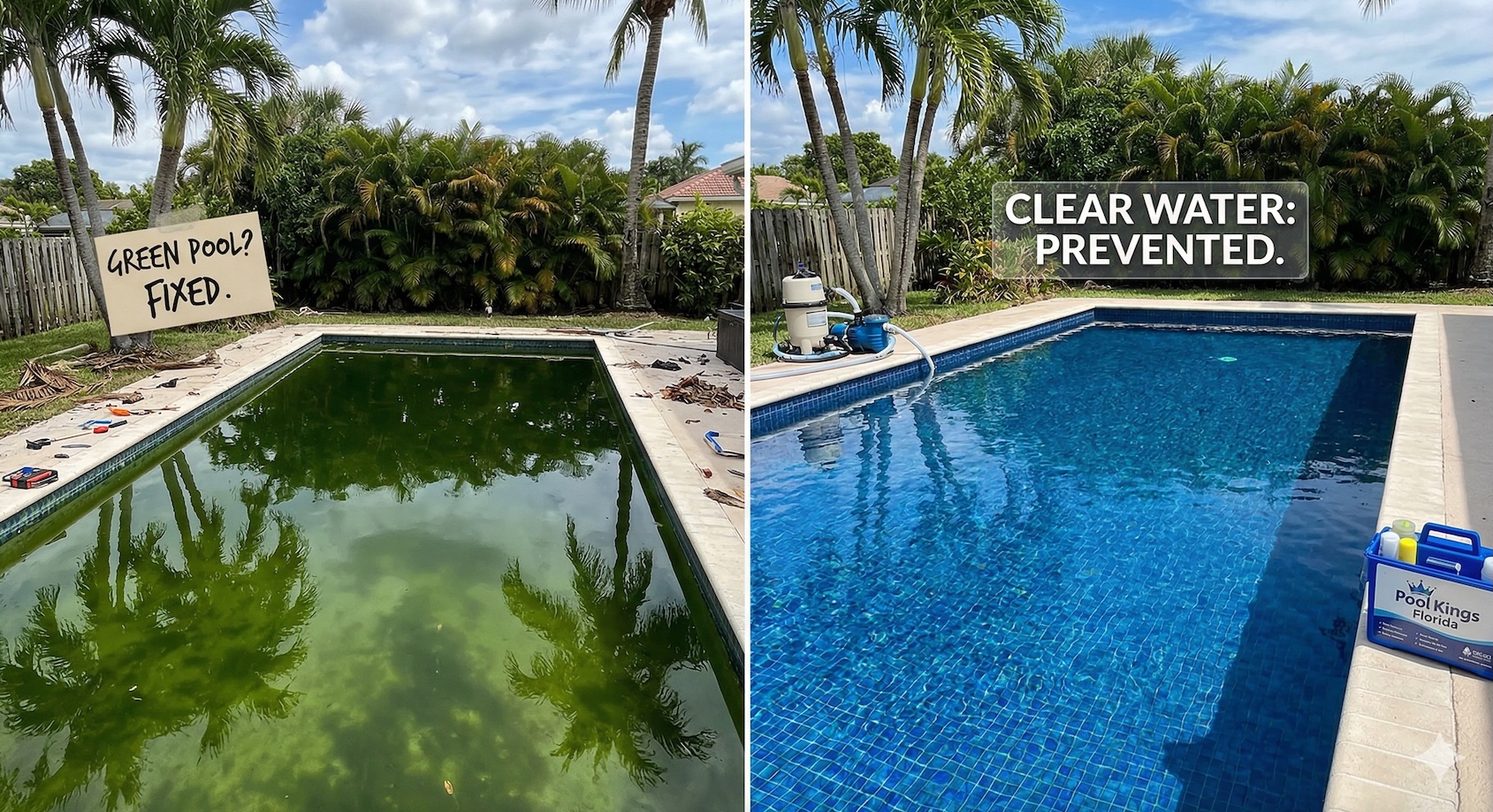
You walk outside, look at your pool, and it’s green. Maybe it happened overnight after a heavy rain. Maybe you skipped a week of maintenance and the algae took over. Either way, you need it fixed — fast.
The good news: a green pool is fixable. The bad news: it takes the right steps in the right order, or you’ll waste time and money and the green will come right back.
This guide walks you through exactly how to get rid of green pool water — and how to make sure it doesn’t happen again.
Why Is My Pool Green?
Green pool water is almost always caused by algae. Algae grows when chlorine levels drop too low to keep it in check — which can happen faster than most people expect, especially in South Florida’s heat and humidity.
Common triggers include:
- Heavy rainfall diluting your pool chemistry
- Missing one or more weekly service visits
- High bather load (lots of pool use in a short period)
- Equipment failure — a broken pump or filter that stops circulating water
- Imbalanced stabilizer (cyanuric acid) that makes chlorine ineffective even at normal levels
Understanding the cause matters because if you shock the pool without fixing the root problem, it will turn green again within days.
How Bad Is It? The Three Levels of Green
Not all green pools are the same. The severity determines how much work and product it takes to fix:
- Light green / teal tint — early-stage algae. You can still see the bottom. This is the easiest to fix, usually within 24–48 hours.
- Medium green — visible algae on walls and floor, murky water, bottom barely visible. Takes 2–4 days to clear with proper treatment.
- Dark green / black-green — you cannot see the bottom at all. Heavy algae infestation. May require a full drain and acid wash to resolve properly.
Step-by-Step: How to Clear a Green Pool
Step 1: Test your water first
Before adding any chemicals, test your water chemistry. You need to know your pH, alkalinity, chlorine level, and cyanuric acid (stabilizer). Shocking a pool with the wrong pH is ineffective — chlorine works best when pH is between 7.2 and 7.4.
Step 2: Balance your pH and alkalinity
If your pH is above 7.4, bring it down with muriatic acid before shocking. If alkalinity is off, correct that first — it anchors everything else. Skipping this step is the most common reason a shock treatment fails.
Step 3: Shock the pool — heavily
For a green pool, a normal dose of chlorine won’t cut it. You need to super-chlorinate — also called shocking — by raising the free chlorine level to 10–30 ppm depending on severity.
Use calcium hypochlorite shock (granular) for best results. For a heavily green pool, you may need 3–4 lbs per 10,000 gallons. Shock at dusk so UV doesn’t burn off the chlorine before it can work.
Step 4: Run your pump and filter continuously
Keep your pump running 24 hours a day until the water clears. The filter is what physically removes the dead algae from the water — without continuous circulation, the chemicals have nothing to work with.
Clean or backwash your filter every 6–8 hours during treatment. A clogged filter slows the whole process dramatically.
Step 5: Brush the walls and floor
Brush all pool surfaces thoroughly — walls, steps, and floor. This breaks up algae colonies clinging to surfaces and exposes them to the chlorine in the water. Do this at least once a day during treatment.
Step 6: Add algaecide (optional but helpful)
After shocking, a dose of algaecide can help prevent regrowth while the chlorine works. Don’t add it at the same time as shock — wait at least 24 hours.
Step 7: Vacuum to waste
Once the water starts clearing and you can see dead algae settled on the bottom, vacuum it out — but set your filter to “waste” mode, not “filter.” This bypasses the filter entirely and sends the debris straight out, so you’re not just recirculating dead algae back into the water.
Step 8: Test again and rebalance
Once the water is clear, test chemistry again and bring everything back to normal ranges. The shock treatment will have consumed a lot of chemicals and things will be out of balance.
How Long Does It Take to Clear a Green Pool?
| Severity | Typical time to clear | Estimated cost (DIY) |
|---|---|---|
| Light green | 24–48 hours | $50–$100 |
| Medium green | 2–4 days | $100–$250 |
| Dark green / severe | 5–7+ days or full drain | $250–$600+ |
How to Prevent Your Pool From Turning Green Again
Fixing a green pool is frustrating. Preventing it is simple — and it comes down to one thing: consistency.
- Weekly service is non-negotiable in South Florida. The climate here is too aggressive for bi-weekly or monthly maintenance. One missed week in summer is often all it takes.
- Test chemistry after heavy rain. Florida storms can dump enough water to dilute your pool chemistry overnight. Check and adjust after any significant rainfall.
- Keep your equipment running. A pump that runs 8–12 hours a day keeps water circulating and chemicals distributed. Still water is where algae thrives.
- Don’t let chlorine run out. Even a day or two with zero free chlorine in South Florida heat is enough to start an algae bloom.
Rather Just Have It Handled? We Can Help.
If your pool is green right now and you’d rather not spend a week troubleshooting chemicals and running to the pool store, Pool Kings Florida can take care of it for you.
We handle green pool cleanups across South Florida — and once it’s clean, our weekly service plans make sure it never happens again. New customers get 50% off their first month.
Call or text us today for a free assessment.
Want to keep reading? Check out our other guides:


Comments are closed